
Scientific Classification
| Kingdom: Animalia |
| Phylum: Brachiopoda |
| Class: Rynchonellata |
| Order: Orthida |
| Family: Tropidoleptidae |
| Genus: Tropidoleptus |
| Species: Tropidoleptus carinatus (Conrad, 1839) |
Information
Geological Range
Paleogeographic Distribution
Stratigraphic Occurrences
References
Linsley (1994): p. 171, figs. 10-24.
Wilson (2014): pp. 96, 97.
Remarks
Originally described as Strophomena carinatus by Conrad in 1839. Recombined as Tropidoleptus carinatus by Hall in 1857.
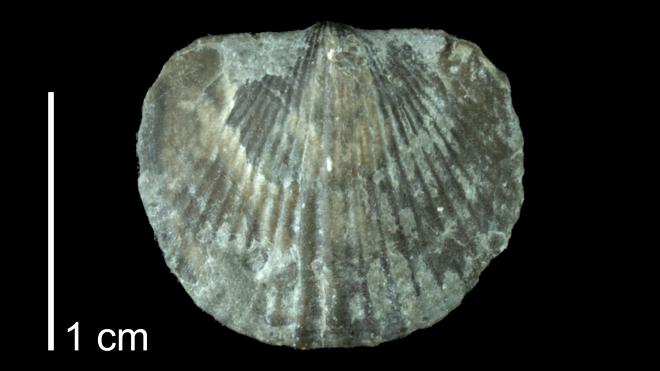
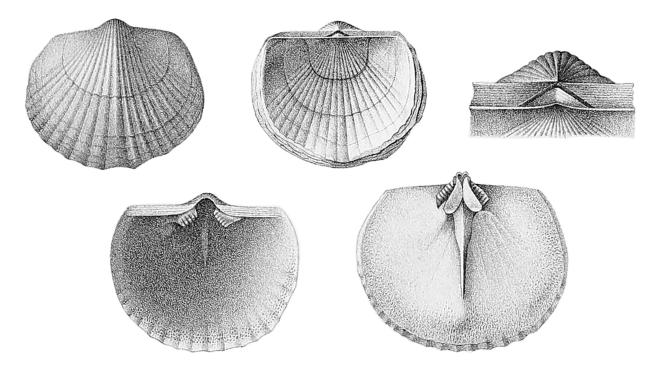
From Wilson (2014, p. 96): “Pedicle valve convex with broad plications and fine growth lines; brachial valve concave. To 20-25mm.”
From Carlton Brett and Gordon Baird: “Tropidoleptus carinatus is an unusual brachiopod. A strophomenid-mimic, the genus has recently been suggested to belong its own order. It is a long ranging species that spans much of the Devonian Period but was clearly not a member of the Eastern Americas Realm and arrived as a part of a wave of immigration of Old World Realm taxa associated with the incoming of the Hamilton fauna and the Kacak global bioevent.; T. carinatus is widespread in nearshore siliciclastic facies of the Appalachian basin, often associated with Mucrospirifer and varied bivalves in siltstone-sandstone facies. It is rare or absent from Diverse brachiopod (e.g., Pseudoatrypa-Megastrophia associations) but occurs abundantly in laterally equivalent mudstone facies with a distinctive suite of other taxa including Devonochonetes coronatus (also an apparent immigrant taxon) and Nucleospira, bryozoans and diverse echinoderms and the domal tabulate Pleurodictyum but generally lacking rugose corals, in beds swirled by Zoophycos, suggestive of high turbidity. This Tropidoleptus-Nucleospira biofacies is best exemplified by the Kashong Shale (Moscow Formation) but also occurs in shallow parts of cycles throughout the Hamilton Group. This brachiopod is commonly encrusted, particularly by Hederella and microconchids. A peculiarity of this species is its abrupt abundant appearance together with D. coronatus in the early Givetian lower Skaneateles Mottville (NY), Rockport Quarry (Ontario subsurface), lower Silica (northern Ohio), and Swanville (IN) formations. This faunal epibole is a useful stratigraphic marker. Curiously, in these units these normally siliciclastic associated brachiopods occur in shallow water carbonate grainstones.; In addition, there are some beds of medium to dark gray shale with low diversity assemblages with other diminutive brachiopods including Cruspina nana, Truncalosia, small Rhipidothyris or even tiny Allanella (see discussion under those species) in the Ludlowville and Moscow formations typical of dysoxic facies, in which bedding planes are covered by diminutive specimens of Tropidoleptus. These specimens which rarely exceed 10 mm resemble small (juvenile) individuals in normal T. carinatus populations. However, they do not form the lower end of a gradient, rather they are a discrete biofacies. It is unclear whether these represent all failed spatfalls with juvenile mortality or rather a small perhaps paedomorphic form of Tropidoleptus.”
Online Resources
Media
Images